
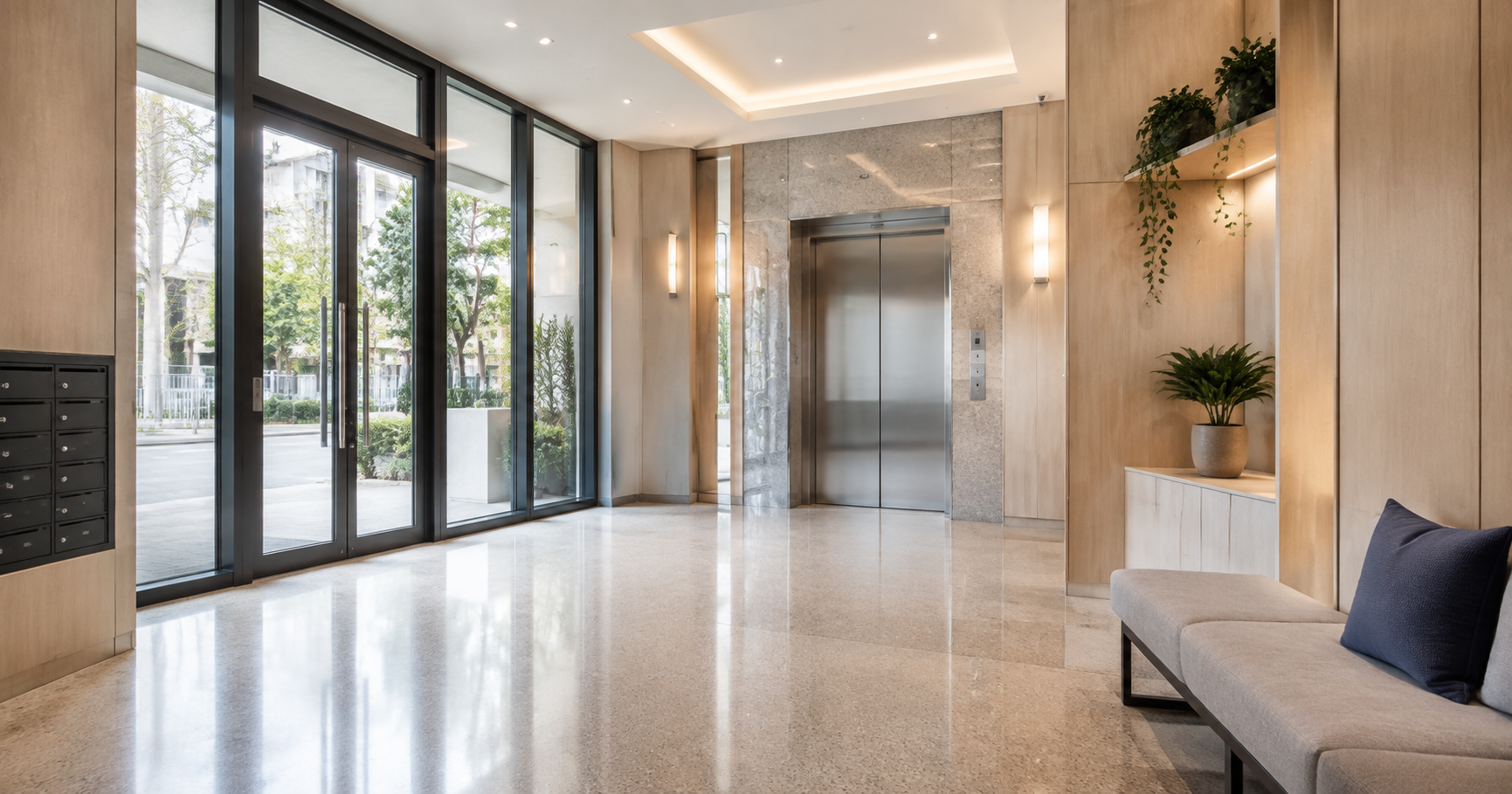
The lobby is the first thing a prospective buyer sees, the last thing a resident walks through at night, and the one part of the building every single owner shares. When it looks tired, smells like the bin room, or has a coffee stain that has been there since autumn, people notice. In strata, presentation is not a nice-to-have. It is tied directly to property values, resident satisfaction, and the reputation of the people managing the scheme.
Yet common area cleaning is one of the most common sources of complaints in strata and one of the hardest things to keep consistent. This guide is for strata managers and committee members who want shared spaces that stay presentable without constant chasing, unexpected costs, or a flood of emails from unhappy owners.
What strata cleaning actually covers
Strata cleaning is the regular cleaning and upkeep of the common property in a residential scheme, meaning everything owners share rather than what sits behind their own front door. The exact scope varies by building, but it usually includes:
- Entries and lobbies: glass doors, foyers, intercom panels, and the first-impression zones.
- Lifts: floors, walls, mirrors, and buttons, which are among the highest-touch surfaces in the whole building.
- Corridors and stairwells: floors, handrails, skirting, and light fittings.
- Car parks and driveways: sweeping, spill management, and periodic pressure washing.
- Bin and garbage rooms: the single biggest source of odour and pest complaints in most buildings.
- Shared amenities: gyms, pools, BBQ areas, rooftop terraces, and common bathrooms.
- Mailrooms and letterboxes, plus common windows and internal glass.
- High-touch points: door handles, rails, buttons, and switches throughout.
Grounds and gardens are sometimes bundled in and sometimes handled separately by a gardener, so it is worth being clear about where the cleaning scope ends and landscaping begins.
Why presentation matters more in strata than people think
It is easy to treat common area cleaning as a box-ticking cost. In reality it quietly influences some of the things committees care about most.
- Property values and saleability. Buyers and renters form an opinion in the lobby before they reach the apartment. A grubby entry or a smelly bin room drags down the perceived value of every lot in the building. As we cover in why your appearance can help or harm your business, first impressions are formed fast and are hard to undo.
- Resident satisfaction and fewer complaints. Consistent cleaning is invisible. Inconsistent cleaning generates emails, agenda items, and friction at every meeting.
- Health and hygiene. Shared spaces concentrate germs on high-touch surfaces, and bin rooms attract pests if not managed. Regular cleaning is part of basic building hygiene, not just looks.
- Safety and liability. Slippery lobby floors, wet entries on rainy days, and cluttered fire stairs are genuine hazards. The owners corporation carries a duty of care for common property, so cleanliness and safety are linked.
In short, cleaning is one of the few building services that touches presentation, health, safety, and money all at once.
What makes strata cleaning different from office cleaning
A strata building is not just an office with apartments on top. A few things make it its own discipline, and they are the reasons a generic contract often disappoints.
- Many stakeholders, one shared space. In an office there is one client. In strata, every owner effectively part-owns the common areas and has an opinion on how they look. Accountability is higher and more visible.
- It runs 24 hours a day. Residents come and go at all hours, so there is no clean-cut after-hours window like an office has. Scheduling has to work around real life.
- Indoor and outdoor combined. Most schemes mix lobbies and lifts with car parks, gardens, and bin areas, so the work spans far more surface types than a typical office clean.
- Budgets come from levies. Cleaning is funded by owners through the administrative fund, so value for money is scrutinised closely and every increase is felt.
- Presentation drives property value directly. In an office, cleanliness supports the business. In strata, it is baked into the asset itself.
This is why choosing a provider who genuinely understands residential strata matters. Our piece on what to look for in a strata cleaning company goes deeper on separating the reliable operators from the rest.
Building the right cleaning scope and schedule
There is no single correct frequency, because a 12-lot walk-up and a 300-apartment tower with a pool are completely different animals. The right schedule is built from a handful of factors.
- Building size and number of lots. More residents means more traffic through every shared surface.
- Amenities. Pools, gyms, and shared bathrooms lift both the frequency and the complexity of cleaning.
- Foot traffic and entrances. Ground-floor entries and lifts take the heaviest wear and usually need the most frequent attention.
- Location and weather. Beachside, leafy, or high-dust areas track more grit and moisture indoors.
- Budget. The scope has to fit what the levies can sustain, which means prioritising the areas that matter most.
A typical scheme lands on a mix: frequent attention on high-traffic and high-touch zones like lobbies, lifts, and bin rooms, lighter routine cleaning of quieter corridors and car parks, and periodic deep cleans for the jobs that do not need doing weekly.
The periodic jobs that are easy to forget
Beyond the regular visits, most buildings need a cycle of less frequent but important work:
- Hard floor stripping, sealing, and buffing in lobbies and corridors.
- Professional carpet cleaning in carpeted common areas, which wear faster than people expect. Our guide to commercial carpet cleaning explains how often and why.
- Pressure washing of car parks, driveways, entries, and outdoor common areas.
- High and low window cleaning, including internal glass.
- Bin room deep cleans and deodorising.
- Graffiti removal and cobweb control.
Folding these into an agreed schedule, rather than treating each as a surprise quote, keeps both the building presentable and the budget predictable.
Safety, insurance, and compliance
This is the part committees cannot afford to overlook. Because the owners corporation is responsible for common property, the cleaning provider is effectively working on shared assets in spaces the public and residents move through constantly.
- Public liability insurance is non-negotiable. If a resident slips on a freshly mopped floor without a wet-floor sign, or property is damaged, the building needs a properly insured contractor standing behind the work. We explain why in why insurance matters when hiring a commercial cleaning company.
- Work health and safety. Cleaners should follow safe systems of work, use correct signage, store chemicals correctly, and understand the hazards of shared residential environments.
- Consistent, trained staff. High turnover is the enemy of a clean building. A stable team that knows the site delivers far more reliable results than a rotating cast who need re-briefing every week.
A cheap quote from an uninsured operator is not a saving. It is a risk transferred onto the owners.
Choosing a strata cleaning provider
Once the scope is clear, the choice of provider is what determines whether the building actually stays presentable. A few things separate a partner from a problem.
- Reliability and consistency. The single most valuable trait. Turning up, every time, to the same standard.
- Clear communication with the strata manager. Cleaning issues should be easy to report and quick to resolve, ideally with a single point of contact.
- Transparent, itemised quoting. You want to see what is included so you can compare fairly. Our guide to comparing commercial cleaning quotes helps committees avoid comparing apples with oranges.
- Proper insurance and credentials, as above.
- Responsiveness to complaints. In strata, issues will surface. What matters is how fast and how well they are handled.
If your current arrangement is falling short, switching does not have to be painful. Our article on how to switch commercial cleaning providers without disruption walks through doing it cleanly, so to speak.
Common strata cleaning challenges, and how to get ahead of them
Most committees run into the same handful of issues. Naming them makes them easier to manage.
- Bin room odour and pests. The most frequent complaint. It needs regular cleaning, deodorising, and good waste habits from residents, not just an occasional hose-out.
- Inconsistent standards. Usually a symptom of staff turnover or a vague scope. A clear scope and a stable team fix most of it.
- Budget pressure. Levies are finite. The answer is prioritising high-impact areas and scheduling periodic work sensibly, not cutting corners everywhere.
- After-hours access and security. Residential buildings need cleaners who respect security, access rules, and residents' privacy and quiet enjoyment.
- Blurred boundaries. Confusion over what is common property versus a private lot, or cleaning versus gardening, causes disputes. A written scope prevents it.
Where Cleancorp fits
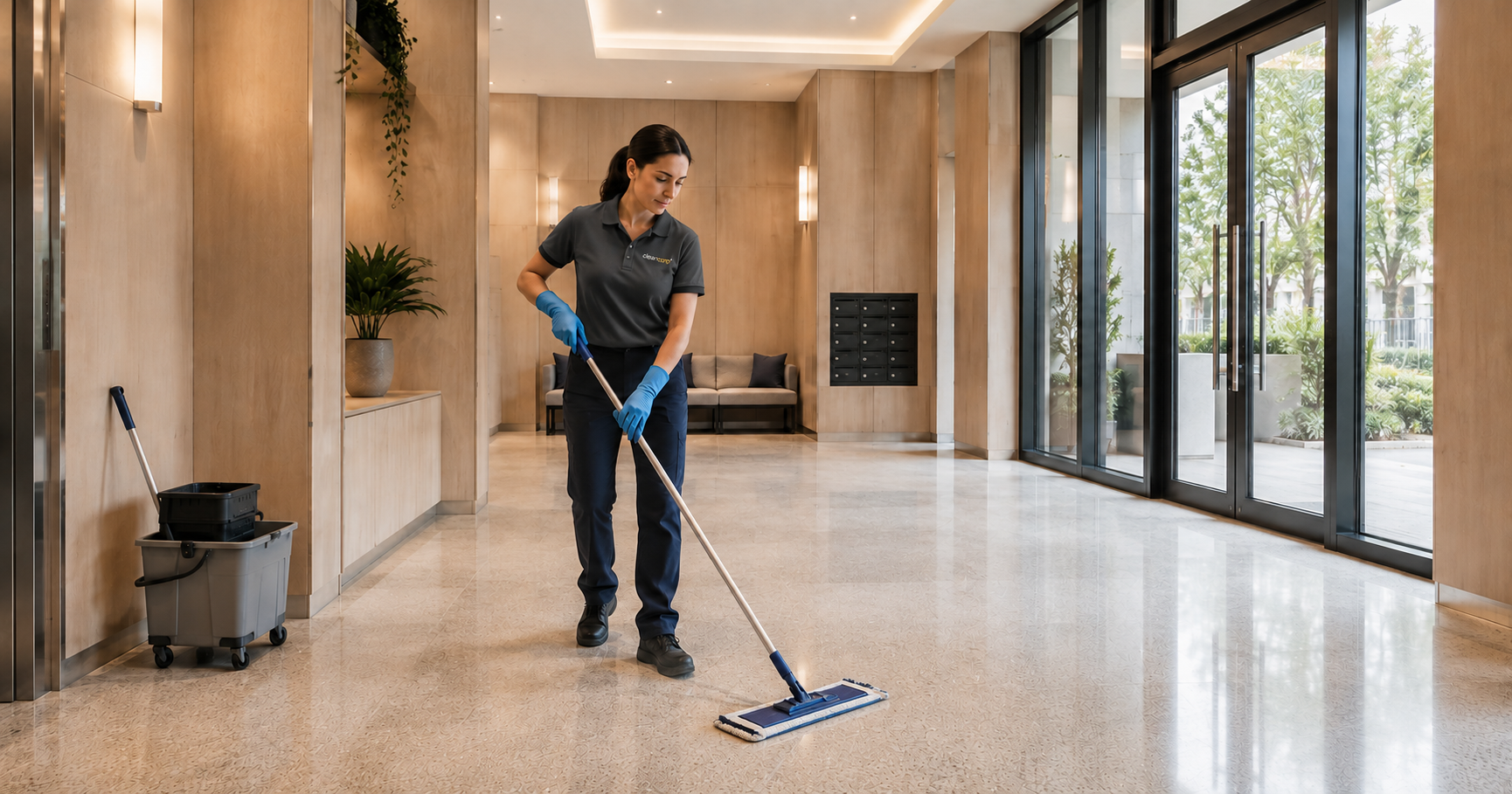
Cleancorp cleans residential strata schemes alongside offices, medical centres, and other demanding environments across Australia. We bring trained, consistent teams, full public liability insurance, clear communication with your strata manager, and a scope tailored to your building rather than a one-size-fits-all package. From daily lobby and lift attention through to periodic carpet cleaning, pressure washing, and bin room deep cleans, we build a schedule that keeps common areas presentable and complaints low, all within a budget the committee can plan around.
Because we also handle the reporting and communication side, your strata manager spends less time chasing cleaners and more time on everything else on their plate.
If your building's common areas are not looking the way owners expect, or you simply want a quote you can compare with confidence, we would be glad to help.
Get a free quote and let's keep your shared spaces looking their best.
Frequently asked questions
What does strata cleaning include?
Strata cleaning covers the regular cleaning of a building's common property, meaning the shared areas rather than the interior of individual apartments. In most schemes that includes entries and lobbies, lifts, corridors and stairwells, handrails and other high-touch points, common bathrooms, bin and garbage rooms, car parks and driveways, mailrooms and letterboxes, and shared amenities like gyms, pools, and BBQ areas. It also typically extends to periodic work such as professional carpet cleaning, hard floor care, window cleaning, and pressure washing of outdoor common areas. The precise scope depends on the building and should be set out clearly in the cleaning agreement, including where cleaning ends and any separate garden or landscaping service begins. A written scope is the best way to avoid confusion later about what is and is not covered.
How often should common areas in an apartment building be cleaned?
There is no single right frequency, because it depends on the size of the building, how many residents it houses, the amenities it offers, and how much foot traffic the entrances and lifts see. As a general pattern, high-traffic and high-touch areas such as lobbies, lifts, and bin rooms benefit from frequent attention, often several times a week or daily in larger buildings, while quieter corridors and car parks can be cleaned less often. Periodic jobs like carpet cleaning, floor sealing, and pressure washing sit on a longer cycle again. The most sensible approach is to match frequency to how each area is actually used, concentrating effort where wear and complaints are highest, and building the whole thing into an agreed schedule so the cost is predictable across the year.
Who is responsible for cleaning common property in a strata scheme?
The owners corporation, sometimes called the body corporate, is responsible for maintaining and cleaning the common property, funded through the levies owners pay into the administrative fund. In practice, the strata manager usually arranges and oversees the cleaning contract on the committee's behalf, and a professional cleaning provider carries out the work. Individual owners remain responsible for cleaning inside their own lots. Because the responsibility for common areas sits with the owners collectively, the standard of cleaning is a shared interest, and it is one of the reasons presentation tends to be scrutinised closely at meetings. Setting a clear scope and choosing a reliable provider is how committees meet that responsibility without it becoming a constant source of friction.
How is strata cleaning different from regular commercial cleaning?
While the core skills overlap, strata cleaning has features that set it apart from a standard office clean. A strata building is used around the clock by residents rather than emptying out after business hours, so scheduling has to fit real daily life. It combines indoor and outdoor spaces, from lobbies and lifts to car parks, bin rooms, and gardens, which spans far more surface types than a typical office. It answers to many stakeholders, since every owner effectively shares the common areas and has a view on how they look. And the cleaning is funded by owner levies, so value for money is watched closely. These differences are why a provider who genuinely understands residential strata tends to deliver more consistent results than one who treats it like any other commercial site.
What affects the cost of strata cleaning?
Several factors drive the price. The size of the building and the number of lots set the baseline, since more residents mean more traffic through every shared surface. Amenities such as pools, gyms, and common bathrooms add both time and complexity. The frequency of cleaning, the range of periodic jobs included like carpet cleaning and pressure washing, and the level of finish the committee expects all influence the figure. Location and local conditions play a part too, as some buildings simply track in more dirt and moisture. The best way to control cost is not to chase the cheapest quote, which often means an uninsured operator or a vague scope, but to get clear, itemised quotes you can compare fairly and to prioritise the high-impact areas that keep the building presentable.
What should a strata committee look for when hiring a cleaner?
Reliability is the single most important quality, because consistent, unremarkable cleaning is exactly what a well-run building needs. Beyond that, look for full public liability insurance, since the cleaner is working on shared property that residents and visitors move through constantly. Look for stable, trained staff rather than high turnover, clear and itemised quoting so you can compare providers on a like-for-like basis, and easy communication with a single point of contact who works well with your strata manager. Responsiveness to complaints matters too, because issues will occasionally arise and what counts is how quickly and how well they are resolved. Checking references from other strata schemes is a simple, revealing step that many committees skip.
How should bin rooms and garbage areas be managed in strata?
Bin rooms are the most common source of odour and pest complaints in residential buildings, so they deserve particular attention. Good management combines regular cleaning and deodorising of the room itself, keeping the floors and bins hygienic, with periodic deep cleans to tackle build-up that routine cleaning leaves behind. It also depends on residents using the room correctly, so clear signage and communication help. Left unmanaged, a bin room quickly generates smells that travel into lobbies and corridors, and can attract pests that become a much larger and more expensive problem. Treating the bin room as a priority area rather than an afterthought is one of the simplest ways to lift the overall impression of a building and keep complaints down.
Can better strata cleaning really improve property values?
It genuinely can, because presentation shapes the impression a building makes on prospective buyers and renters, and that impression starts in the common areas. A clean, fresh lobby, spotless lifts, and odour-free bin rooms signal a well-run building that owners care about, which supports the perceived value of every lot. A tired, grubby entry does the opposite, and it can quietly reduce what people are willing to pay or the rent a landlord can achieve. Consistent common area cleaning also protects the physical assets, from carpets and hard floors to glass and outdoor surfaces, extending their life and avoiding premature replacement costs. In that sense, cleaning is not just an operating expense. It is a modest, ongoing investment in the value and reputation of the whole building.